
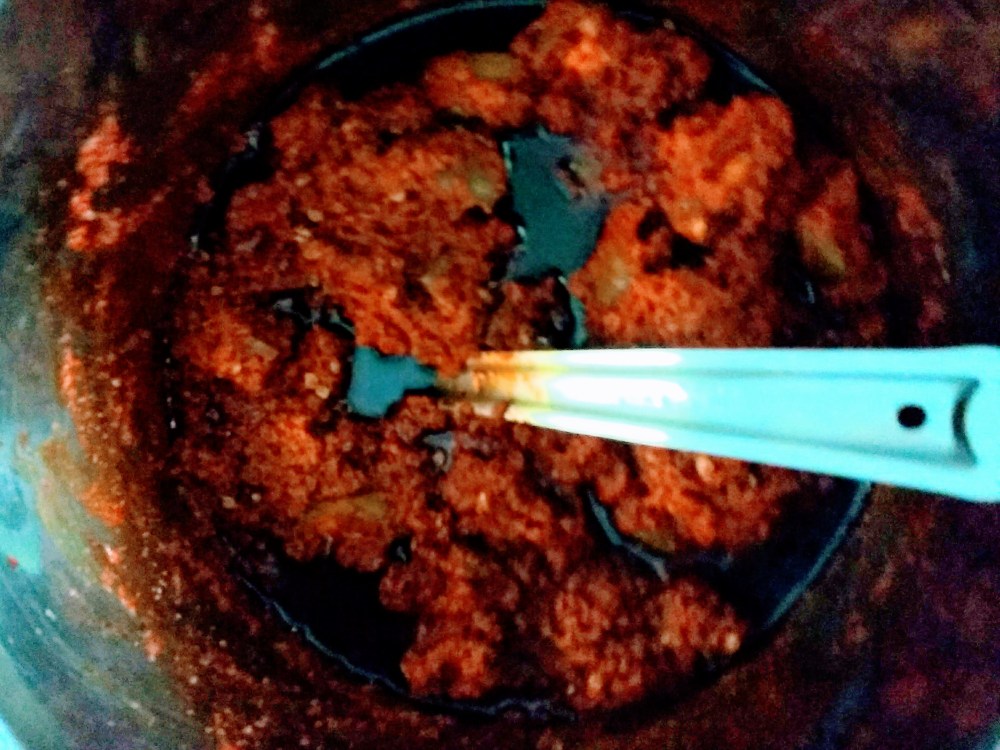
Here comes the emperor of Andhra food 🤴 Loved by one and all, this fiery wonder can magically transform any food it accompanies into a lip-smacking speciality. Breakfast, lunch, dinner and even snacks are enjoyed with this sovereign pickle.
Come summer, households get into a frenzy of preparing pickles and odiyams. It is the time for mangoes – the chieftains, for extreme heat needed for some varieties of pickles and all odiyams. It is straight tradition. period.
Mothers prepare large quantities of pickles to give their children, particularly daughters. It is an annual allowance taken for granted. While daughters who got them from their mothers for a great number of years boasted about it, women who weren’t in such a position and so started making them from an early age boasted about their pickling age! I belong to the second category.
Amma had given me all the avakai in my school years itself, in my lunch box 😅 everyday with curd rice. I ate that same thing for lunch for seven years in high school. After my marriage I got my pickles from MIL for 2 years. After that I ventured into pickling as I was very enthusiastic about cooking and keen on achieving culinary distinction. Pickle making marks a person’s eminence in cookery.
In the olden days, people used to prepare all the pickle ingredients at home – pound and grind various powders. Primarily mustard powder, chilly powder. They wait for the mangoes to come to the right stage for each type of pickle. Some people have a contract with a tree owner to supply them certain number of mangoes. One necessary and sufficient quality for mangoes is for them to be sour. Then depending on the pickle type, they will have to be fibrous, thick skinned, juicy, thick shelled etc., For avakaya mango should have a thick outer cover, slightly fibrous with a long seed the entire length of mango with a mature shell. They will then clean them and cut using kathi-peeta and go about the preparation.
Now, all the powders are store-bought, branded. So preparation is not that laborious. Some people grind mustard at home to ensure they are spicy. Biggest challenge is in getting the good quality mangoes. Going to the market lined with heaps of mangoes from various vendors, evading the brokers who try to drag you into some sub-standard ones, haggling with vendors who always outsmart you, checking for the specs tasting a sample from each chosen vendor and finally making sure we get the type we chose without any wrong or damaged ones. (Many times they show you one for sample and load your bag with inferior ones)
We should also fix a person to cut them. Here also we must be careful in selecting the person – checking that he has the right knack of cutting without damaging the piece, that his tool is sharp enough and finally the rate for cutting is reasonable. We either clean the mangoes there itself taking with us some water, cloth, clean bags, newspaper etc or bring them home, wash and wipe and take them back for cutting. At home we clean the pieces clear of seed, skin of shell, any stubborn dirt etc and keep them ready.
I learnt making pickles from ammamma (ISI). She is extremely meticulous. She would have a proper calculation for the ingredients though she herself approximates as required. Desired size and shape of the vegetable – mango, lemon, amla everything she would specify. Having trained in her school I also acquired the tendency to almost compulsively stick to the rules – ingredients, methods. I used to be proud of it in those days. Now at this time of my blogging/recording, my cooking business has shrunk so much that I cant say that I ‘am’ still a proud stickler for those rules.
My MIL was also an expert at this obviously. She used to say that her expertise is in correcting the pickles that didnt come out right, than making them perfectly in one go. Actually she always made them flawlessly. She used to correct and improve other unfortunate or amateur people. An important motivation for persisting with avakaya preparation is that my son loves this. He cares for this alone to be packed for him to the US, well, at least until recently 😌
Before we set out to make the pickles, we should have all the vessels, plates, ladles needed during the preparation ready – washed, wiped clean and dried well under the sun or lightly heating it over the stove to remove any moisture.
In spite of all this intimidating fuss, the process is very exciting. We pray to God for its success and go about the preparation with devotion. Once done and it passes the taste test, you are set for the year. Really avakai is the secret behind any successful meal in Andhra.
Ingredients:
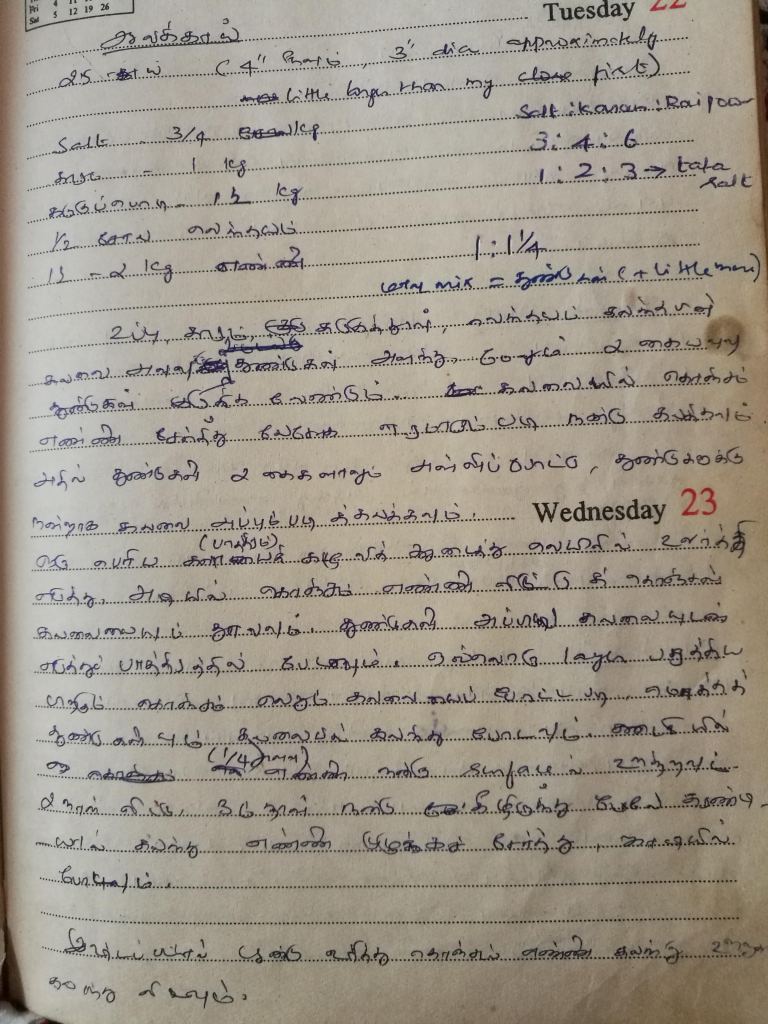
- Mangoes – 25 (4″ long, 3 inch dia approx; little longer than my fist)
- Salt – 3/4 kg
- Chilli powder – 1 kg
- Mustard powder – 1.5kg (salt: karam: Mustard pow = 3:4:6. In case of tata salt 1:2:3)
- Methi seeds – 1/2 sola
- Sesame oil – 1.5 to 2kg
Method:
- Wash and dry the mangoes. Cut them (or get it done by cutting people) into pieces. These are cut along with the shell of the seed. One vertical cut to halve it, then quarter it, remove the seed and wipe it clean. Now perpendicular to the length cut 2 inch pieces, each having a piece of the seed-shell and the piece should be cleanly cut without any damage. After all the pieces are cut, go over them and remove all damaged ones because they may/will cause the pickle to get spoilt in a short period.
- You can sieve mustard powder and karam once. If we are confident it is good, can use directly.
- Mix salt, chilly powder, mustard powder and methi together.
- Measure this mixture using a large vessel. Now measure the mango pieces and ensure that they are about 1.25 times the mixture.
- In a large basin spread the mixture of powders and add oil little by little. Rub the oil against the mixture such that it becomes slightly wet with oil, but still loose. It changes to a somewhat deeper colour.
- Now add handful of mango pieces to this and rub the mixture against the pieces so that they are completely covered in the powder.
- Take a deep and wide vessel, pour oil into it and swirl it so that the bottom is layered in oil Now sprinkle a handful of the mixture all over the bottom.
- Now place the mixture covered mango pieces in the vessel, by gathering them with both hands along with some mixture.
- Add more pieces to the basin of mixture, repeat the same. After a few times, sprinkle just the mixture on top of the pieces in the vessel covering them.
- Repeat the process until all the pieces and the mixture(leave a little) are evenly used up and placed in the vessel.
- On the top layer sprinkle the remaining mixture to cover the pieces fully.
- Now pour 25% of the total oil on and around the top surface, cover with a clean lid and keep aside.
- On the third day, take a long laddle and mix the contents of the vessel. By now mangoes would have released their juice upon interaction with salt and the mixture loosens a lot. Adding all oil slowly mix the contents gently and thoroughly without damaging the pieces.
- Transfer it into a clean, dry jar with a tight lid and store for the year (and more)
- For Ulli avakaya, dry peeled garlic pods in sun for 15 minutes, mix little oil to it and add these to the avakaya. Usually a portion is turned into ullavakaya.
- For bellam avakaya, half the measure of jaggery is mixed with one measure of avakaya and this is placed in a wide vessel and placed under hot sun for couple of days until jaggery becomes thick syrupy and the mixture is sticky and stretchy when scooped with a spoon.
- Most people love the pungent taste of fresh avakaya. When eaten mixed with hot rice and a generous helping of sesame oil, this tastes heavenly.
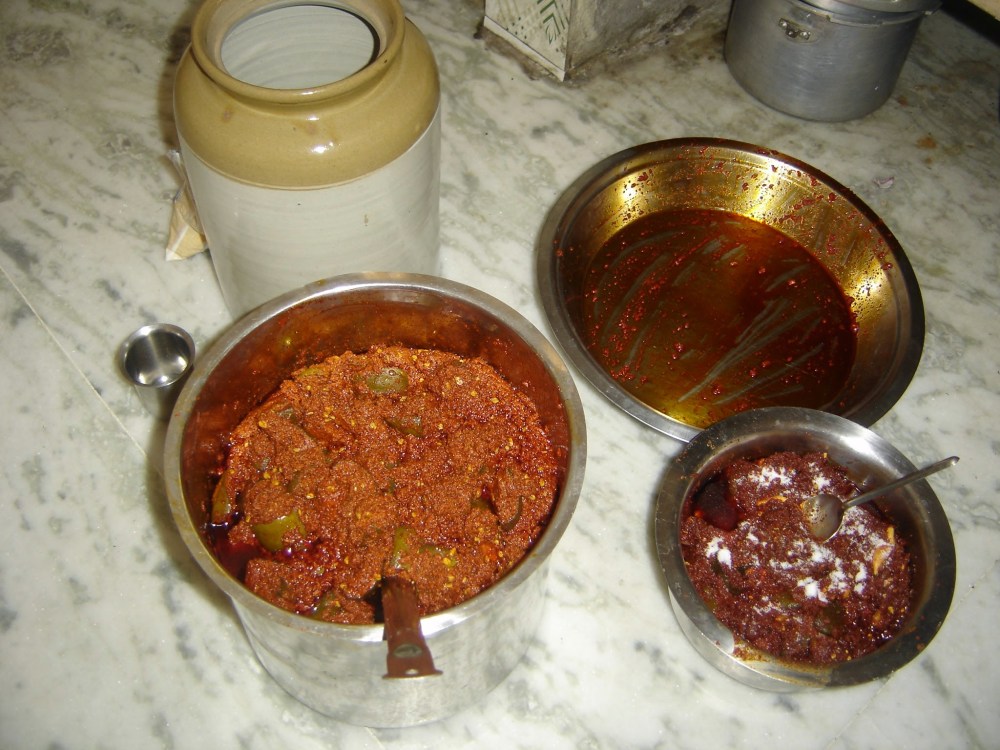
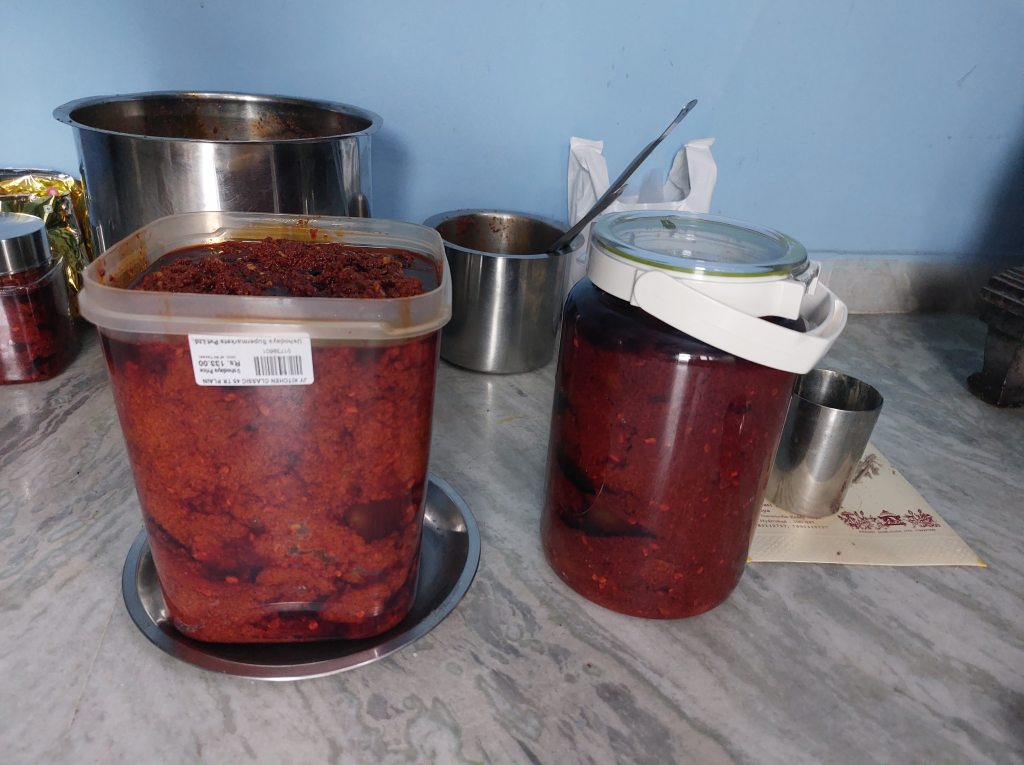
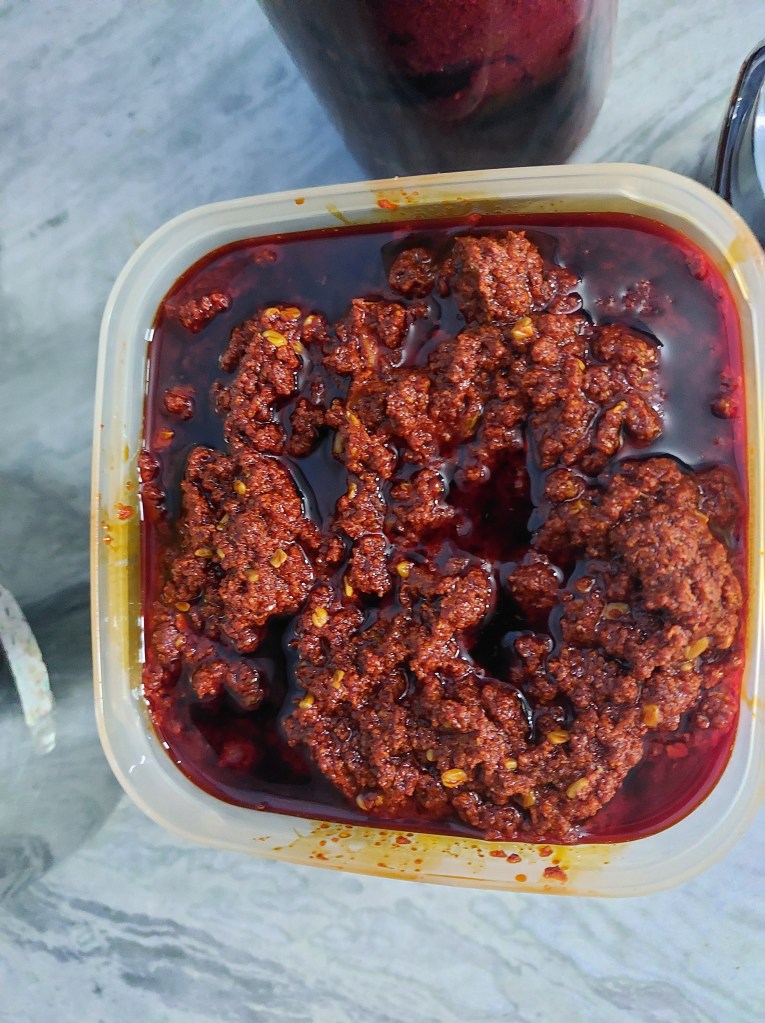
Note:
- Certain varieties of mangoes are best suited for avakaya. Chinna rasalu, suvarnarekha, even tella gulabi(I find this too fibrous to like) etc. But ammamma and MIL both say local varieties called ‘desavali’ are the best. They look a little roundish than longish.
- Avakaya goes with rice, tiffin items like idly, dosa, uppindi, etc. In my son’s boarding school he and his friends used to eat murukku with avakaya.
 A Spring in your Step