

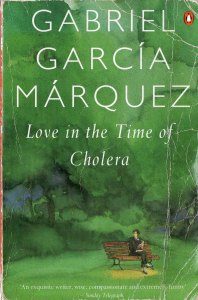
‘Love in the Time of Cholera’ by the celebrated Columbian novelist Gabriel Garcia Marquez is an intriguing work of fiction. I thoroughly enjoyed his masterpiece ‘One hundred years of Solitude’ and so was motivated to read this one.
When I first read the excerpts of this novel I thought it is the love story of the main characters Florentino Ariza and Fermina Daza told in the glorious style of Marquez’s magical realism. And after reading well over ten percent of the book I thought the title actually refers to the placid love of the elderly couple Dr. Juvenal Urbino and Fermina Daza. I was amazed, quite disappointed and somewhat bored to find that it is about all the passions felt by all these characters through a period of sixty-plus years.
The narration is undeniably brilliant stringing seemingly disjointed pieces and times into a fantastic tale. You can’t help marvelling at the way each sentence is so beautifully, cleverly crafted making almost all of them quotable quotes.
 I have to admit that despite my somewhat liberal leanings the culture I am accustomed to is rather conservative and as such my perception of the ideas dealt in this book will be relative to that. So a feeling of disgust over an insane six hundred plus love affairs over half a century, even with a child of fourteen at a ripe old age, is unavoidable. But even within the scope of the story I was surprised to see contrasting moral stands of the characters in the same time frame.
Urbino’s friend Jeremiah kept his love affair a secret in order to be free of the society’s prejudices and Urbino himself was shocked that ‘he had chosen the hazards of illicit love’. Though he later reasons with his wife that it was his deception he is infuriated with and not the act itself, the narrative gives enough evidence to believe that he was upset about his friend’s secret love. He himself deviated bringing havoc to his marriage and he was hinted to have been in a longstanding affair with Daza’s friend at that very time.
Arizo went wild maybe because he believed ‘the body carries on for as long as you do’ but wanted to guard it a secret for Daza’s sake. The umpteen partners Arizo had were varying in their degrees of morality – from one who was murdered by her husband for her infidelity to a casual ‘unfaithful but not disloyal’ lover. Daza remained faithful to her marriage, but Arizo wondered if she too strayed. Daza’s daughter fiercely objects to her mother’s involvement with Arizo as ‘revolting at their age’. But Daza’s daughter-in-law has a lot more liberal view of love at any age. Finally though almost everyone including Daza is disinclined to her romantic relationship with Arizo, she succumbs to his schemes.
I do not know what to surmise: no standards, double standards or widely varying standards?
 A Spring in your Step